
Insights into the contributions of KJ in the ZAM Whatsapp group
Thank you, Sir, for your kind words. I stand humbled. The msg below is rather long , apologies in advance.
Without going into personal details, my 15 years in this wonderful country—Zambia—have given me both the passion and the focus for national development. I have encountered immense talent among the youth: eager, capable, and driven to succeed, yet often lacking guidance on how to progress, aggravated by an absence of structured mentorship.
As the former Founding Chairman of the Kaizen Club of Zambia, an industry-led initiative created to promote Kaizen principles, we worked closely with JICA to inculcate a culture of continuous improvement within industry. Unfortunately, we were largely unsuccessful in embedding collective learning practices and making Kaizen a mantra in day to day work. Over time, JICA withdrew its support, and the Kaizen Institute—established under MCTI and the Ministry of Labour ( think it has gone to Min of SME) —has since focused primarily on government institutions.
As a student of management and a Six Sigma Green Belt holder, with experience in high-precision manufacturing environments, it is my humble view that Zambian industry, collectively, has yet to fully embrace a sustained quest for excellence. A basic first step in this journey is the adoption of certified Quality Management Systems (QMS)—such as ISO 9001—which signal to customers that systems exist not only to deliver quality, but also to identify root causes and permanently eliminate failures. Today, fewer than 100 companies in Zambia hold even this most fundamental certification.
I regularly interact with young Zambians who possess tremendous potential but lack the “ladder” to climb. While many individuals and firms are undoubtedly doing commendable work independently, there is far greater opportunity if we act collectively. A holistic and mandatory internship framework, with standardized performance evaluation and closer industry–academia collaboration, is one such area I have consistently emphasized. As members of ZAM, this can be initiated collectively.
For industry players, there are significant opportunities to build competence through Industrial clusters. Drawing from my experience as part of high-precision automotive component clusters in India, I have made sustained efforts—together with MCTI and industry associations—to institutionalize this concept locally. Many countries that once had GDP per capita levels comparable to Zambia—such as South Korea, Taiwan, and Singapore—have multiplied their economic output many times over (see snapshot below). A key differentiator has been competence development and reduced dependence on natural resources. Developing clusters will in course of time address competence availability locally ( without need to import talent), and also address common problems.
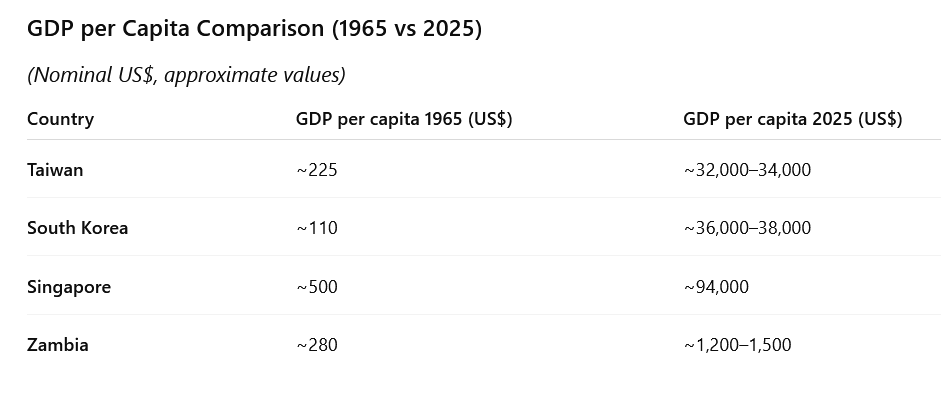
My focus, therefore, remains firmly on National Competence Development and how industry can benefit collectively—what cluster theory describes as local external economies and collective efficiencies. My PhD research, available on my website (click on KJ Phd thesis), was centered precisely on this theme.
Individually, many of us—and our companies—may be performing excellently. Yet, as a collective ecosystem, we may still be underperforming. None of my statements have ever targeted a specific company or sector. Nor is my primary interest in routine issues such as black markets, policy volatility, or exchange rate fluctuations—important as they are—because these are often effects, not root causes.
This does not diminish their importance. I have acknowledged before that these issues matter. However, we must also engage in deeper conversations on how to position Zambian industry as a platform for excellence.
Is this difficult? Absolutely.
Is it impossible? No—other nations have demonstrated that it can be done.
This is why I continue to advocate for initiatives that promote cost reduction, superior quality, and robust human capital—human capital that can one day be exported globally, as India has done—without in any way belittling the genuine challenges faced by industry.
In my interactions with consumers, I have observed customers instinctively choosing imported products over local alternatives—even when Zambian products are competitively priced and of equal or better quality. When asked why, many respond simply that they were unaware such products existed. This perception must change. Zambian products and services must become the UNCONSCIOUS FIRST CHOICE.
Until that happens, the positions I have articulated earlier—despite the objections they have attracted—will remain relevant. They are not directed at any individual or organization. I may be wrong—but I do not believe I am very wrong.
Given that the discussions started day before yesterday evening with the price reductions expected was contested for with various explanations, I was trying to emphasis that if the products and services were excellent, the consumers may not even be bothered on one hand in paying a slightly higher price, and on the other, by adopting several cost saving measures using Kaizen , ISO companies can also have better leverage and contribution to handle such volatility giving consumers the confidence and motivation. All these are absolutely within our control of execution and can result in upto 25% of cost savings , that can be passed on to the customer or retained. In essence this was the point.
I hope this provides a fair explanation of my occasionally ambiguous statements ( in light vein).
For any further discussion, please feel free to DM me.
Warm regards,
KJ
www.krishjaga.com
THIS PAGE WILL BE DELETED ON 20th JANUARY 2026